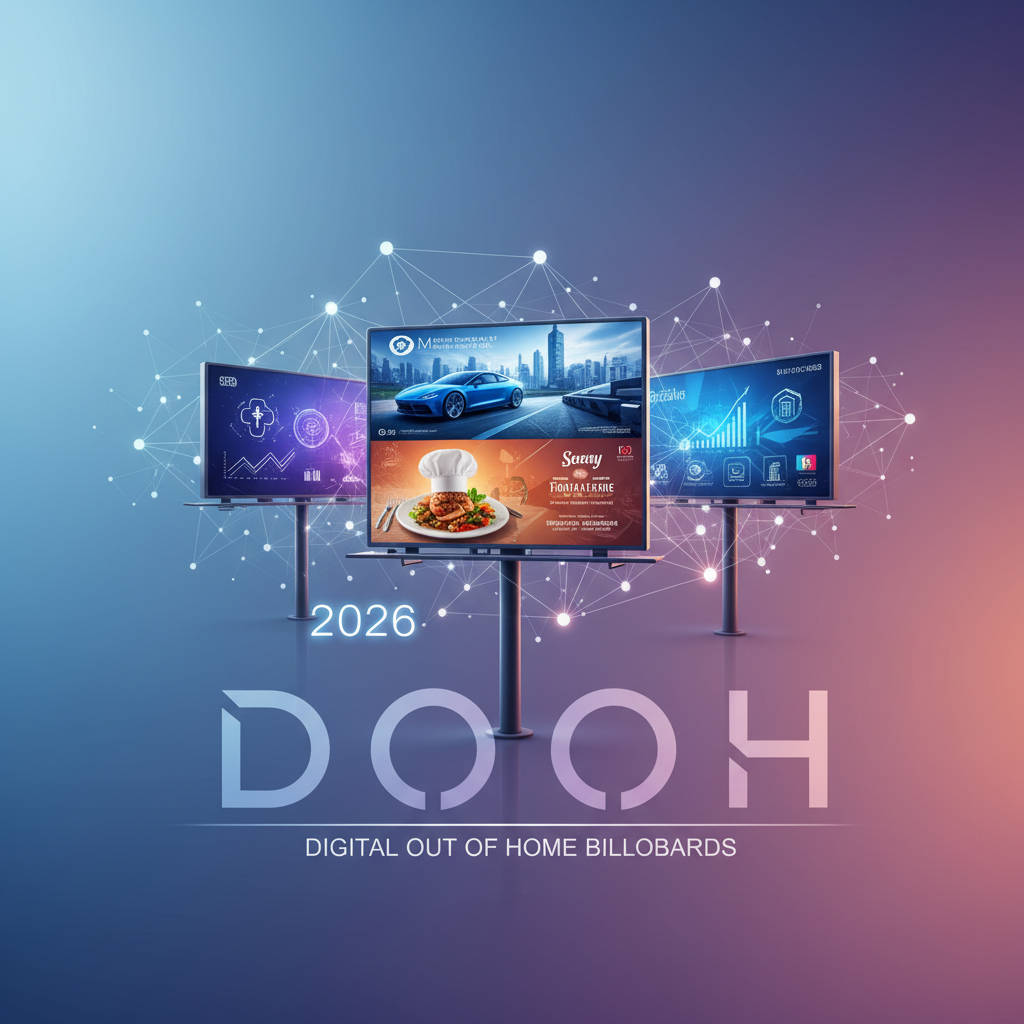
How to tailor DOOH for your industry: A 2026 guide to digital billboard advertising
Key Takeaways
- DOOH can be highly tailored for specific industries, offering significant advantages over generic campaigns.
- Success hinges on understanding your target audience, defining clear objectives, and strategic location selection.
- Creative content must be concise, visually strong, and feature a clear call to action for quick comprehension.
- Programmatic DOOH enables precise targeting based on audience, time, location, and context, optimising ad spend.
- Continuous measurement and optimisation are crucial for maximising ROI and adapting campaigns for better performance.
Digital Out-of-Home (DOOH) advertising is no longer a one-size-fits-all solution. In 2026, its adaptability allows businesses to craft highly targeted campaigns that resonate with their specific customer base. Whether you operate a local restaurant, a retail chain, a professional service, or a property developer, understanding how to customise DOOH for your industry can improve advertising effectiveness.
This guide outlines the prerequisites for a successful, industry-specific DOOH campaign, provides step-by-step instructions on tailoring your approach, and offers troubleshooting tips to help your message connect with your audience. We explore how different sectors can use digital billboards to achieve marketing objectives, from increasing footfall to boosting brand awareness in places like Greater Manchester.
Prerequisites for industry-specific DOOH success
Before launching your tailored DOOH campaign, ensure you have these foundational elements in place. These prerequisites will maximise the impact and efficiency of your advertising spend.
- Clear understanding of your target audience: Who are you trying to reach? What are their demographics, behaviours, and daily routines? For instance, a local cafe targets commuters, while a luxury car dealership targets affluent professionals. Knowing this allows for precise screen selection and creative messaging.
- Defined campaign objectives: What do you want to achieve? Is it increased sales, brand recall, lead generation, or driving traffic to a specific location? Specific objectives allow for measurable results and optimisation.
- Appropriate budget allocation: Understand your budget and how it aligns with your campaign goals. Digital billboards offer flexible options, from short-term bursts to sustained visibility, with costs varying based on location and duration. For a clear understanding of costs in the Manchester area, see our guide on Manchester Billboard Costs: 2026 Pricing Guide.
- High-quality creative assets: Your ad needs to be visually compelling and concise, designed for quick comprehension. Remember the 3-second rule: your message must be absorbed almost instantly by passing traffic. Our Billboard Ad Design Service UK can help create screen-ready artwork tailored to your needs.
- Location strategy: Identify key locations where your target audience congregates or passes by. For example, a sports shop might favour screens near gyms or sports centres, while a theatre would look for screens in entertainment districts.
- Measurement strategy: How will you track the effectiveness of your campaign? This could involve unique QR codes, specific landing page URLs, or monitoring footfall increases. Businesses in Stockport are already seeing data-driven success through measurable DOOH conversions.
Step-by-step guide to tailoring DOOH for your industry
Follow these steps to develop a DOOH strategy that addresses your industry's unique demands and your audience's needs.
Step 1: identify your industry's unique communication needs
Every industry has distinct communication challenges and opportunities. Consider what messages resonate most with your customers and what information they seek.
- Retail: Focus on promotions, new product launches, seasonal sales, and location-specific offers. Visuals of products in use or clear calls to action are effective.
- Hospitality (restaurants, cafes, hotels): Showcase appealing food and drink, inviting interiors, special events, or booking information. Consider dayparting, where different ads run at different times of the day (e.g., breakfast offers in the morning, dinner specials in the evening).
- Automotive: Highlight new models, special financing offers, test drive opportunities, or after-sales services. High-quality imagery of vehicles is paramount.
- Property & real estate: Feature attractive property images, open house dates, new developments, or contact details for agents. Emphasise lifestyle benefits rather than just specifications.
- Professional services (legal, financial, healthcare): Build trust and authority. Use clear, concise messaging about expertise, services offered, and contact information. Consider using testimonials or trust marks.
- Education: Advertise open days, course enrolment deadlines, unique programmes, or campus life. Appeal to aspirations and future opportunities.
- Entertainment & events: Promote upcoming shows, concert dates, ticket availability, or special guest appearances. Dynamic content like short video clips can be engaging.
Step 2: select strategic screen locations
The physical placement of your DOOH ad is critical. Choose locations that align with your target audience's daily movements and where your message will be most relevant.
- Proximity to point of sale: For retailers and hospitality, screens near your physical location can drive immediate footfall. For example, a restaurant advert on a nearby busy road.
- High traffic routes: For general brand awareness, screens on major arterial roads or motorways offer broad reach. Our flagship screen on London Road, Hazel Grove, Stockport reaches 52,000 vehicles daily, making it suitable for high-impact campaigns.
- Relevant environments: Place ads for gyms near office blocks, or ads for family attractions near residential areas. Consider the context of the location; an ad for a solicitor might be more effective near a business park.
- Event-specific locations: If promoting an event, consider screens near venues, transport hubs, or areas with high footfall from potential attendees.
Step 3: optimise creative content for impact and readability
Your creative is your voice. It must be clear, compelling, and tailored to the fast-paced nature of DOOH viewing. For further insights, explore Creative strategies for local DOOH advertising in Greater Manchester.
- Minimal text: Use no more than 7-10 words. Get straight to the point.
- Large, legible fonts: Ensure readability from a distance and at speed.
- Strong visuals: High-quality images or short, dynamic videos grab attention. For a restaurant, this might be a mouth-watering dish; for a car dealership, a sleek vehicle.
- Clear call to action (CTA): What do you want viewers to do? Visit a website, call a number, or stop by a store? Make it obvious.
- Brand consistency: Maintain your brand's colours, fonts, and tone of voice to build recognition.
- Dynamic content: Use DOOH's ability to change content based on time of day, weather, or even real-time events. A coffee shop could display a hot coffee ad on a cold morning and an iced latte on a warm afternoon.
Step 4: implement programmatic DOOH for enhanced targeting
Programmatic DOOH allows for automated buying and selling of ad space, offering sophisticated targeting capabilities previously unavailable to many businesses. This benefits small businesses aiming for efficiency and precise audience engagement.
- Audience-based targeting: Reach specific demographics or interest groups based on anonymised mobile data, running your ad only when your target audience is most likely to be present.
- Time-based targeting: Schedule ads to run at peak times for your business, such as lunchtime for restaurants or after-work hours for retail.
- Location-based targeting: Target screens within a specific radius of your business or a relevant landmark.
- Contextual targeting: Display ads based on external factors like weather, traffic conditions, or local events. A tyre shop could promote winter tyres during a cold snap.
For a deeper dive, read our Programmatic DOOH for Small Business (2026 Guide).
Step 5: measure and optimise your campaign
Monitoring your campaign's performance is crucial for understanding what works and refining your strategy for future success.
- Track key performance indicators (KPIs): These could include website visits from a specific URL or QR code, increased phone enquiries, footfall tracking, or social media mentions.
- A/B testing: Experiment with different creative variations or calls to action to see which performs best.
- Analyse data: Use the insights gained to adjust your screen locations, ad scheduling, or creative content. For example, if a lunch offer performs well on weekdays but not weekends, adjust your schedule accordingly.
- Iterate and improve: DOOH is dynamic. Use your learnings to continuously improve your campaigns and maximise your return on investment.
Troubleshooting common DOOH challenges
Even with careful planning, challenges can arise. Here are solutions to common issues you might encounter:
- Low engagement: If your ad is not generating interest, review your creative. Is the message clear and concise? Is the visual appealing? Is your call to action obvious? Consider simplifying the message or using a stronger visual hook.
- Limited reach: If you are not reaching enough of your target audience, reconsider your screen locations and programmatic targeting parameters. Are you advertising where your customers actually are?
- Budget constraints: For smaller budgets, focus on highly targeted campaigns with shorter durations or fewer screens. Prioritise screens closest to your business or those with the highest relevance to your specific audience. Also, consider the cost-effectiveness of local advertising; local billboard advertising can often outperform national campaigns for Stockport businesses.
- Creative production difficulties: If you lack design resources, consider using tools like our AI Ad Maker for Digital Billboards which can generate screen-ready video ads from a simple prompt, or utilise our professional design service.
Expected results of a tailored DOOH strategy
By carefully tailoring your DOOH campaigns to your industry and audience, you can expect a range of positive outcomes:
- Increased brand awareness: Consistent, targeted visibility builds strong brand recognition within your desired demographic.
- Enhanced local presence: For local businesses, DOOH can boost visibility within your immediate trading area, driving more local customers to your door.
- Higher engagement rates: Relevant and well-designed ads capture attention more effectively, leading to better recall and interaction.
- Improved return on investment: By focusing your spend on the most impactful locations and times, you achieve more for every pound spent.
- Competitive advantage: Stand out from competitors who may still be relying on less dynamic or less targeted advertising methods.
Conclusion
In 2026, Digital Out-of-Home advertising offers businesses across all sectors an opportunity to connect with their audiences in a powerful, memorable way. By understanding your industry's unique needs, strategically selecting locations, crafting compelling creative, and using programmatic capabilities, you can transform your outdoor advertising into an effective marketing engine. Tailored DOOH places the right ad, in the right place, at the right time, for the right audience.
Ready to see how tailored DOOH can benefit your business? Explore our Screen Locations or get in touch with our team to discuss your specific industry needs. We are here to help you maximise your impact and achieve your advertising goals.
Edited by Shahram Ghorbanian